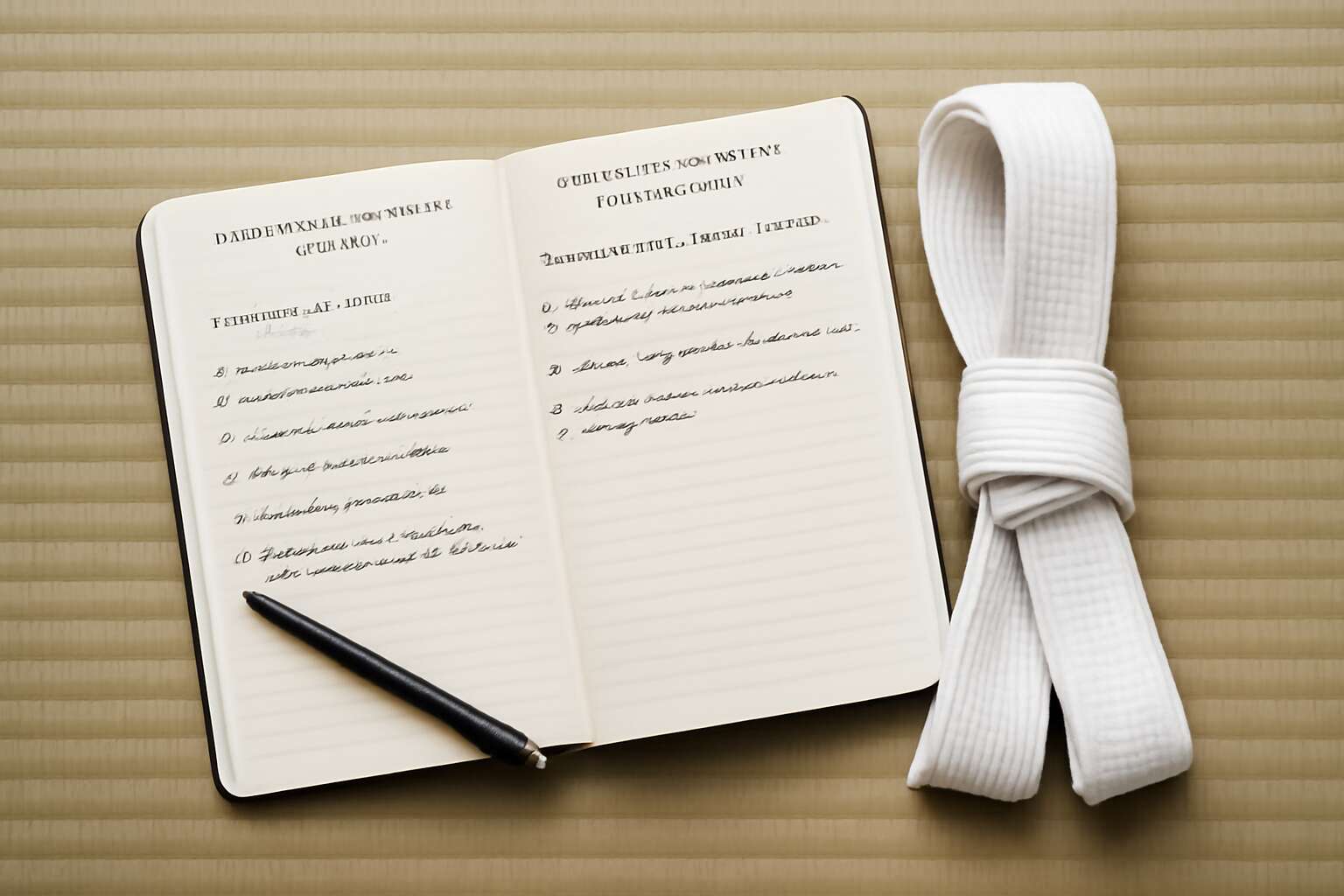
Foundations and goals for a BJJ training journal
Why keep a training journal
On South Africa’s mats, from dusty gym floors to veld corners, a brazilian jiu jitsu journal isn’t just notes; it’s a map. A recent club chat hinted that athletes who write after each session report sharper focus and fewer plateaus. The habit feels intimate and practical—a handshake between body and memory. Foundations set the tone: honesty, consistency, and curiosity about every roll.
Foundations begin with simple commitments: show up, note what happened, and name what you felt. Goals should be process-led, not just medals—techniques to refine, positions to master, and a rhythm for rest and recovery that keeps you moving forward.
Within the journal, you might track these elements:
- Technique focus and drill details
- Roll outcomes and positional goals
- Energy, mood, and recovery signals
- Lessons learned and next steps
In this way, the journal becomes more than pages; it becomes a witness to the quiet, daily courage of every practitioner.
What to track in a training journal
On South Africa’s mats, progress arrives quietly. In fact, 68% of athletes who keep a training journal report sharper focus within eight weeks. Foundations in a brazilian jiu jitsu journal are not rigid rules but a living pact—honesty about what happened, a steady cadence of notes, and a patient curiosity about the body’s signals.
- Show up with honest intent and observe without judgment
- Record the sequence and the body’s immediate impressions
- Name the felt shifts—tension, ease, fatigue
- Let entries guide patient, process-led growth
Goals become process-led: not chasing medals but refining technique, sharpening positions, and syncing rest with momentum. The journal functions as both mirror and compass, mapping daily courage on the mat and quietly extending your arc toward mastery.
Choosing a journaling format
Foundations and goals for a brazilian jiu jitsu journal aren’t rigid rules; they’re a living pact that travels with the mat. Consider that 68% report sharper focus within eight weeks. Honesty about what happened, a steady cadence of notes, and a patient curiosity about body signals keep the practice honest and evolving.
Format matters more than fancy gear. A well-chosen journaling format reduces friction and makes entries feel effortless, so consistency stays high.
- Pocket notebook that rides in the gi
- Digital app with tags and searchable notes
- Voice notes captured right after rolling
Ultimately, the journal becomes a compass on South Africa’s mats, steering toward technique refinement, balanced rest, and momentum that ages like wine rather than a sprint.
Key metrics for progress
In South Africa’s training halls, progress whispers through the journal more clearly than the clock on the wall: 68% report sharper focus within eight weeks.
Foundations and goals for a brazilian jiu jitsu journal anchor the practice in candor and patience. Like a map drawn on the mat, they invite steady cadences, honest reflections, and a curious listening to body signals that keeps growth human—I’ve watched it do so, time after time.
- Consistency of entry cadence
- Honest, concise notes on each roll
- Mindful interpretation of bodily cues
Key metrics for progress rise beyond scores; they measure cognitive clarity, depth of technique notes, and recovery balance. This journal traces entry rhythm, position-specific observations, and fatigue trends across weeks, revealing patterns memory would miss.
Common journaling mistakes and how to avoid them
Foundations and goals anchor the practice in candor and patience. In South Africa’s gyms, a purpose spoken aloud on the mat becomes a compass in the notebook—steady, not punitive. Set clear aims: what you want to understand about your game, how you want to move, and how you want to recover. With that north star, entries unfold with honesty and a quiet curiosity about the body’s signals. For a brazilian jiu jitsu journal, this clarity keeps growth human and focused.
Common journaling mistakes creep in; here’s how to avoid them:
- Vagueness over specifics—grips, positions, and decisions fade into generalities and you miss patterns.
- Overloading pages—too much data drowns insight; keep a single focus per entry.
- Ignoring recovery cues—sleep, stress, and nutrition are as important as technique.
Digital vs paper journal options
Foundations are the compass, and goals the map—clarity turns sparring into study. On South Africa’s mats, a purpose spoken aloud on the day’s first drill becomes the compass guiding a notebook after the final roll. The brazilian jiu jitsu journal should carry that honesty into every page, tracing body signals with patient curiosity rather than punitive judgment.
Digital vs paper journal options bring distinct rhythms worth choosing with care.
- Digital: rapid edits, searchable notes, cloud backups
- Paper: tactile memory, deliberate entries, fewer distractions
- Hybrid: core reflections on paper, quick logs on a device
Set aims that linger: what grips and positions reveal about strategy, how movement surfaces in the hips, and what recovery cues—sleep, stress, and nutrition—signal readiness. With that north star, entries stay human, focused, and alive to the body’s quiet language.
Structuring journal entries for effective BJJ practice
Daily entry template
A sharp entry in a brazilian jiu jitsu journal can compress a week’s learning into a clear, actionable map. A little discipline here yields a surprising dividend: better recall, sharper focus, and fewer “what did I even drill?” moments after rolling—whether you train in Cape Town or Joburg. Begin with the date and session tag to anchor memory.
Adopt a concise daily template to keep momentum:
- Date and session type (e.g., morning drilling, sparring)
- Primary focus (e.g., guard passing, posture, grips)
- Drills and reps completed
- Observations and adjustments (what clicked, what didn’t)
- Next goals for the following session
Keep it breezy and candid—clear notes beat pomp and filler! The journal becomes a quiet coach, guiding each roll and drill with wit and patience as you train toward clear, measurable improvements.
Technique notes and annotations
A single, well-structured entry can turn a week of rolling into a repeatable map. In South Africa, coaches note sharper recall and faster adaptation when notes stay precise and brief. A well-placed line on a tough pass can cut hesitation on the mat by half during sparring.
In a brazilian jiu jitsu journal, structure the entry around technique notes and annotations. Record not only what happened but why it mattered. Tag moments of control, exposure, and transition, then use that label to guide future sessions.
- Technique notes: position, grips, base, leverage
- Annotations: what clicked, what needed adjustment, why
- Roll log: partners, pressure, and responses to angles
This approach keeps a quiet coach in your corner, guiding your progress in the gym from Cape Town to Joburg and beyond.
Rolls and sparring outcomes
Clarity on the mat starts with clarity in the notebook. A sharp log can turn a tough roll into a teachable map. In a brazilian jiu jitsu journal, entries should be structured to capture not just what happened but why it mattered. The best pages tag moments of control, exposure, and transition, guiding future sessions.
Consider these core sections:
- Technique notes: position, grips, base, leverage
- Annotations: what clicked, what needed adjustment, why
- Roll log: partners, pressure, and responses to angles
That structure acts as a quiet coach in your corner, a steady guide from Cape Town to Joburg and beyond!
Drills, repetitions, and cadence
Cadence on the mat begins with cadence in the notebook. In a brazilian jiu jitsu journal, small notes after each drill translate chaos into a map, guiding your next roll with intent.
Frame entries around three axes: drills cadence, repetition density, and tempo. Record who you rolled with, where balance held, and what switch in angle changed the outcome—then note why those clues mattered for your growth.
To keep readability, a concise checklist anchors your entry without turning the page into a workbook.
- Drills cadence and rhythm
- Repetition density and consistency
- Tempo, breath, and base
With time, the brazilian jiu jitsu journal becomes a quiet coach—from Cape Town to Joburg and beyond.
Competition prep and reflections
A quiet notebook can become the quietest advantage in a crowded arena. A brazilian jiu jitsu journal steadies memory, turning freeform chaos into a map of intent. On competition prep, structure matters less as a set of rules and more as a narrative spine—context, reflection, and forward-looking interpretation weaving through each entry. From the mat to the pages, the craft feels almost alchemical.
Within the journal, a few anchors keep reflections legible when the adrenaline fades. Consider these:
- Opponent tendencies, guard progression, and your response
- Balance, base, and weight distribution under pressure
- Angles that altered outcomes and the reasons they mattered
Across SA mats—from Cape Town to Joburg and beyond—the journal remains a quiet coach, translating practice into perspective and ambition into habit.
Technique logging and drilling records
Positional details and transitions
Across South Africa’s mats, a recent studio poll found that practitioners who maintain a brazilian jiu jitsu journal with technique logging see a 17% faster gain in positional play.
Technique logging and drilling records turn repetition into a map. Log the starting position, the drill objective, and the transitions—guard to knee-slice, to side control, to mount—and the precise cues and grips that matter. Track tempo, resistance, and whether the finish was clean or required adjustments. This quiet archive becomes a storyboard you can read between sessions, guiding deliberate, flourished progress in positional details and transitions.
Fields to capture include:
- Starting position and drill goal
- Key transitions and positional details
- Grips, angles, weight distribution
- Tempo, reps, resistance level
- Outcome and next steps
This approach turns practice into narrative, inviting future sessions to build on yesterday’s notes.
Submission setups and counters
On South Africa’s mats, one sharp stat slices through the chatter: a brazilian jiu jitsu journal helps practitioners unlock submission setups and counters, delivering about 17% faster gains in positional play. The page becomes a mirror where intention meets repetition, turning guesswork into a lucid map of effort and outcome.
Technique logging for submissions starts with a simple frame: record your starting position and the drill goal, then trace the setup like a constellations map. Note the grips, angles, and weight distribution that turn pressure into leverage, and log tempo so you can repeat or disrupt the rhythm in future rounds.
- Starting position and goal
- Primary submission setup and key cues
- Counters to escape or reverse the flow
- Outcome and next steps
That quiet archive becomes a narrative you read between rounds, guiding deliberate, flourished progress in submission details and counters.
Timing, grips, and energy management
On South Africa’s mats, a sharp stat cuts through chatter: a brazilian jiu jitsu journal boosts positional gains by about 17% as athletes translate practice into precision. The page becomes a compass where intention maps to results, turning guesswork into a lucid trail of effort and outcome.
Technique logging begins with a simple frame: the starting position and the drill aim are sketched, then the setup is traced like a constellations map. I note grips, angles, and weight distribution that turn pressure into leverage, and I log tempo so future rounds can repeat or disrupt the rhythm with intention.
Energy management sits at the heart of every roll. I track breath, cadence, and bursts of effort, letting the brazilian jiu jitsu journal tell me when to push and when to ease off, keeping performance steady across rounds rather than burning bright and fading.
This quiet archive becomes a narrative you read between rounds, guiding deliberate progress in technique, timing, and response to counters while maintaining a sense of wonder on the mats.
Common problems and corrective notes
Technique logging in a brazilian jiu jitsu journal turns each drill on South African mats into a data point. I sketch the starting position and drill aim, then map the setup like a constellations guide. I note grips, angles, and weight distribution, and log tempo so future rounds can repeat or disrupt the rhythm with purpose.
- Vague notes that don’t tie to a drill outcome
- Inconsistent terminology across sessions
- Notes kept in isolation, no cross-link to counters
- Skipping reps or sessions, yielding incomplete records
Corrective notes shift the focus: translate each mishap into a concrete action, assign a quick test for the next drill, and tighten the language so the next log reads like a progress bar, not a diary of excuses.
Progressive drilling plan
On the mats, every grip and angle is a clue. What gets measured, grows—so a brazilian jiu jitsu journal turns a drill into a map from problem to control.
Technique logging records the starting position, drill aim, and setup, then maps grips, angles, weight distribution, and tempo. Future rounds repeat the rhythm or disrupt it with purpose.
To convert notes into progress, deploy a progressive drilling plan:
- Define the objective for the drill and the quick test you’ll run next.
- Capture setup details—grips, angles, and posture—in precise terms.
- Add a rapid resistance or partner cue to test the response.
- Log results with concise language that reads like a progress bar.
This approach keeps the brazilian jiu jitsu journal practical for SA practitioners pursuing steady, data-driven improvement.
Mindset, goals, and motivation tracking
Setting SMART goals for BJJ
Across South Africa’s mats, a blunt truth lands: athletes who keep a brazilian jiu jitsu journal progress faster. Momentum comes from deliberate reflection, not wishful thinking—on days energy wavers, I notice the smallest cues early.
- Specific: target a technique or position
- Measurable: count reps or rounds
- Achievable: pace progress within a realistic window
- Relevant: tie goals to competition or belt milestones
- Time-bound: set a clear horizon
Mindset shapes every guard pull. Setting SMART goals for BJJ keeps ambition tethered to reality: Specific, Measurable, Achievable, Relevant, Time-bound. This framework guides entries and prevents aimless wandering on the mat.
Motivation thrives when you remember why you train. Your brazilian jiu jitsu journal can host concise notes on triggers, small wins, and the mindset shifts that lure you back to the dojo with curiosity, not bravado.
Habit formation and consistency
Across South Africa’s mats, 63% report sharper focus when they keep a brazilian jiu jitsu journal. Momentum takes shape where reflection slices through bravado, and ink becomes a quiet lantern in the gym’s midnight hush.
Mindset guides every guard pull; the journal serves as watchful witness to triggers, small wins, and the shifts that keep pursuit from melting into gloom.
- Triggers and cues behind training days
- Incremental wins and subtle improvements
- Energy and focus levels during rolls
- Cadence of practice and recovery rhythms
In the quiet after the drill, consistency becomes a ritual; let the brazilian jiu jitsu journal be a lantern through SA’s shadows, guiding habit formation toward steadier nights and cleaner moves.
Post-session reflections and learning
In South Africa’s gyms, 63% report sharper focus when they carry a brazilian jiu jitsu journal after sessions. The post-roll glow becomes a compass, not a souvenir, guiding the mind toward purpose as the mats grow quiet.
Mindset becomes measurable when I reflect with candor. Post-session reflections turn adrenaline into insight, naming triggers, small wins, and the shifts that keep pursuit from waning. The journal translates a night of rounds into a steady rhythm, a cadence that tunes motivation to stay the course.
- What pulled my effort today and why it mattered
- One concrete learning from a roll, big or small
- How my energy and focus shifted as the session progressed
- A micro-goal for tomorrow aligned with the longer arc
The page becomes a lantern through SA’s shadows, a witness to progress and a gentle reminder to return to the mat with renewed intention.
Mental routines and focus strategies
Sixty-three percent of SA gyms report sharper focus when they carry a brazilian jiu jitsu journal after sessions. That truth isn’t just a statistic—it feels like a map. I treat mindset as a daily ritual, not a spark of feeling.
My mental routines hinge on two anchors: brief breath resets and brutal honesty during reflection. I name triggers, celebrate small wins, and chart the cadence of the roll; this turns adrenaline into insight and keeps motivation from waning as fatigue settles in.
To translate effort into direction, I lean on a compact framework:
- Breath resets mid-rolling and in cooldown
- Post-session honesty with a single truth about focus
- One micro-goal that threads into tomorrow’s arc
These pages keep the mind disciplined, the goals honest, and the path toward mastery tangible.
SEO-friendly templates and tools for journal content
Keyword research and variant ideas
In the hush after a roll, a brazilian jiu jitsu journal becomes a lantern for mind and mat. An SEO-friendly template can guide readers with the precision of a kata, lighting a sharp hook, clear body, and a closing that lingers. In South Africa, readers crave atmosphere as much as accuracy, and that balance earns the search engines’ quiet respect.
To keep the content lean yet luminous, consider these elements:
- Template skeletons for intro, body, and CTA that stay consistent across posts
- Keyword research tools and variant prompts to spark angles without filler
- Meta and heading templates to keep the journal cohesive and discoverable
Keyword research and variant ideas should feel organic, not contrived, guiding long-tail queries, questions, and niche angles around grappling rhythms, training cycles, and journal benefits, while letting the prose breathe.
On-page SEO best practices for journal posts
The page is a guard; if you can’t open it, nothing else matters. In the hush after a roll, templates become a kata: a sharp hook, a breathing body, a closing that lingers. South African readers crave atmosphere as much as accuracy.
For a brazilian jiu jitsu journal, the template leans on long-tail queries that surface after a session—what changed, which detail unlocked a new escape, how did mindset shift toward the mat? Tools like Google Keyword Planner, Answer the Public, and Ubersuggest spark angles with no filler, and variant prompts invite fresh takes.
On-page SEO best practices anchor the journal’s reach: tight title tags, clear meta descriptions, semantic headers, accessible alt text, and coherent internal links keep readers and search engines in harmony.
Internal linking and content clusters
Punchy templates turn sweat into strategy. For a brazilian jiu jitsu journal, the page becomes a dojo of intent when posts mirror a roll: tight opening, clear progression, memorable finish. SEO-friendly templates keep readers moving toward the next connected thought.
Tools like Google Keyword Planner, Answer the Public, and Ubersuggest spark long-tail angles after a session. They surface questions worth answering: how a detail unlocked a new escape, or how mindset shifted on the mat!
- What changed after a drill
- Which detail unlocked a new escape
- How mindset shifted on the mat
Internal linking and content clusters stitch the journal into a navigable ecosystem. A pillar page backed by linked entries keeps the journal coherent and discoverable.
Schema markup and rich snippets for training content
On the mat, a crisp journal entry acts as a compass, steering reflections toward practice with purpose. In a brazilian jiu jitsu journal, clean templates turn sweat into strategy and keep momentum from drying on the page. The mat remembers what the drill forgets.
SEO-friendly templates echo the cadence of a roll, guiding readers from one insight to the next with ease. For training content, Schema markup and rich snippets signal meaning to search engines, spotlighting drills, cues, and outcomes without clutter.
- Schema.org types such as HowTo, FAQPage, and QAPage.
- JSON-LD to embed structure without altering layout.
- Rich snippets that surface lesson goals and outcomes.
South Africa’s dojo floors are listening; harmonize the journal and markup to become a searchable map for eager practitioners.
Lead magnets and conversion optimization
Within South Africa’s digital dojo, a well-tended brazilian jiu jitsu journal attracts readers, holds attention, and converts curiosity into practice. A crisp stat to set the pace: templates that guide the read flow outperform cluttered pages, turning skimmed visits into thoughtful engagement.
SEO-friendly templates align with Schema.org types such as HowTo, FAQPage, and QAPage, while JSON-LD embeds keep structure neat without invading layout. When your content follows these patterns, drills, cues, and outcomes surface clearly to searchers.
As for lead magnets and conversion signals, they rise naturally with well-considered templates.
- sticky lead magnets aligned with drills
- clear metadata and concise CTAs
- exclusive previews that reward engagement
Readers feel the map, and momentum stays with them.



0 Comments